
DOE for formulation development: screening and balancing responses
Structure a formulation DOE around feasible factors, quality guardrails, interactions, and independent confirmation before using the result.
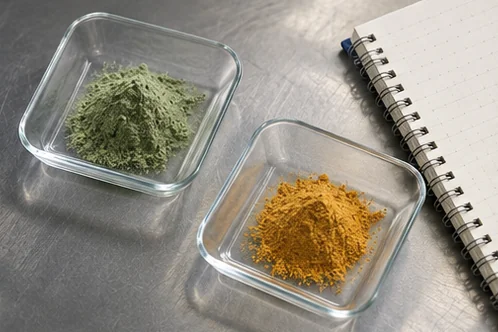
A formulation DOE helps a team choose which candidates deserve independent confirmation. Define what a candidate has to deliver, which constraints limit the region you can study, and how the team will decide when responses disagree. The worked example is a fictional blend of inert color components. All proportions, scores, and limits are teaching values.
Write the decision as an acceptance rule
Separate the response you want to improve from the requirements a candidate must meet. In the example, coverage is the primary response and measurement variation is a guardrail. The project team sets a minimum coverage score of 80 and a maximum variation score of 3.0 before it examines any results. A favorable coverage score does not outweigh an exceeded variation limit.
Agree how you will compare two candidates that both pass. You might prioritize lower uncertainty, higher coverage, or a composition farther from a feasibility boundary. Write down the tie-breaker before choosing a model. The design then has a clear decision to support.
Separate composition from independently adjustable settings
Composition shares a fixed total. In a three-component example, A, B, and C must sum to 100%. Increasing A changes the options for B and C. A conventional factorial treats factors as independently adjustable, which would produce infeasible corners if applied to all three proportions.
Use a mixture design to represent the feasible proportions. When the blend has additional bounds, plan over the constrained region. Pure-component points may be outside that region. Some studies also include an independently adjustable process factor. Discuss a mixture-process design if you intend to learn whether the preferred composition changes across settings.
| Blend | A / B / C (%) | Coverage ≥80 | Variation ≤3.0 | Point-estimate result |
|---|---|---|---|---|
| A | 50 / 30 / 20 | 82 | 2.4 | Passes both |
| B | 60 / 25 / 15 | 87 | 4.1 | Fails variation |
| C | 40 / 35 / 25 | 79 | 1.9 | Fails coverage |
| D | 45 / 25 / 30 | 85 | 2.7 | Passes both |
Reserve enough data to check the model
A small first study can eliminate poor regions and identify candidates worth reviewing. Choose design points that let the model reflect plausible blending behavior. If the goal is to fit curvature, the design should include information inside the feasible region. Exact repeats can help estimate repeatability when they are independently prepared.
Blocking may be useful if preparation spans days or material lots. Arrange the allocation so that candidate classes are still comparable within the study. Keeping every high-A composition on one day, for example, would make a day effect harder to distinguish from a composition effect.
Read the example before choosing a candidate
In the table, Blend B produces the largest coverage score but exceeds the variation guardrail. Blend C stays below the variation limit but misses minimum coverage. Blends A and D satisfy both point-estimate rules. These four rows illustrate candidate screening. Fitting and validating the model would require a study designed for that purpose.
Bring each potentially acceptable candidate to a review with its estimate, uncertainty, and distance from the limits. The best predicted point can be a fragile choice when modest shifts in the blend or noise in the measurement could put it over a boundary.
Plan the confirmation before closing the study
The final design brief should show the objective, feasible bounds, candidate rationale, and the evidence still needed. A team can then review the next study separately from the exploration that produced the shortlist.
- Document the feasible region, exact unit assigned to each composition, and any preparation or measurement blocks.
- Check residuals and report uncertainty for each response that can overturn the decision.
- Use independent preparations to compare shortlisted blends against the reference, with the same acceptance rules and an explicit response to an inconclusive result.
Further reading
Explore Shadow AI for Pharma →