
Full factorial vs. fractional factorial DOE: how to choose
Compare run counts, aliases and interaction trade-offs in full and fractional factorial designs, with a practical selection checklist.
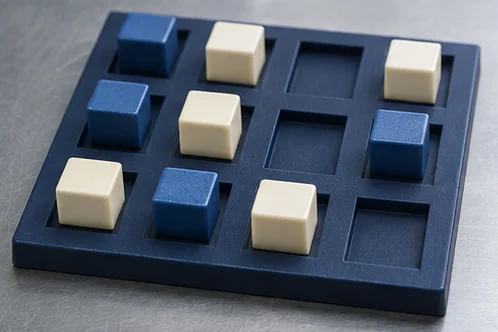
Use a full factorial when you need to distinguish several plausible effects and can afford to test every combination. Use a fractional factorial when you need a smaller screening study and can state which effects may be mixed together. Write the decision the experiment must support before comparing run counts. A four-run design is only cheaper if the answer it produces is useful.
A factor is a setting you change. Its levels are the options you test. An interaction exists when the effect of one factor depends on another setting. In a software benchmark, for example, cache settings might have a large effect with small batches and almost none with large batches. The average cache effect alone would hide that difference.
Eight combinations or four?
Imagine you are benchmarking synthetic files. Factor A is cache off or on, factor B is light or heavy compression, and factor C is small or large batch size. Use processing time for a fixed workload as the primary outcome and record failures separately. With two levels per factor, the full factorial has 2 × 2 × 2 = 8 combinations before independent repeats or checks. The worked matrix marks the subset kept by a four-run half fraction.
Code the two levels as − and +. For this half fraction, keep the rows where the sign in column C equals A multiplied by B. For example, − multiplied by − gives +. The other four rows belong to the complementary half, where C equals the negative of A multiplied by B. The table lists design combinations. Randomize the run order within any restrictions you define.
| A · Cache | B · Compression | C · Batch size | Half fraction |
|---|---|---|---|
| − | − | − | Other half |
| − | − | + | Keep |
| − | + | − | Keep |
| − | + | + | Other half |
| + | − | − | Keep |
| + | − | + | Other half |
| + | + | − | Other half |
| + | + | + | Keep |
Read the alias table before interpreting an effect
In the four-run fraction, column C is identical to the A-by-B interaction column. A contrast attributed to batch size could reflect batch size, the cache-by-compression interaction, or both. The same issue affects A with B-by-C and B with A-by-C. This is a resolution III design. The main effects have distinct columns from one another, while each is aliased with a two-factor interaction.
If the team has reason to expect the cache and compression settings to interact, choose a design that can separate that interaction from batch size. In this example you can start with all eight combinations or reserve the four complementary rows and analyze both halves together. If the two halves must run in separate periods, record the periods as blocks. With one half in each period, that block difference is confounded with the three-factor interaction.
Count the complete study and the uncertainty it can estimate
The number of combinations is only the first line of the budget. Counting each independently initialized benchmark session as an experimental unit, two independent sessions per combination require 16 sessions for the full factorial and 8 for the half fraction. Re-reading the same recorded result leaves the number of independent sessions unchanged.
The unreplicated four-run fraction has no residual degrees of freedom for a model with an intercept and all three main-effect columns. An unreplicated eight-run full factorial also has no residual degrees of freedom if you fit every factorial term. Plan independent replication or justify a reduced model and the assumptions it requires. Replicating the same fraction can improve precision and estimate noise, while the identical columns and their aliases remain.
A decision checklist for design review
- Write down the main effects and interactions the decision depends on. For a candidate fraction, get the full alias table and check those terms individually.
- Count independent units, reference checks, infeasible setting combinations, and confirmation runs before accepting the apparent savings.
- If the first stage is a screen, agree how you will follow up an ambiguous signal. Put the complementary runs, timing, and budget in the plan.
- If the decision is about a best setting within a continuous range, remember that a two-level screen describes the corners. Reserve a later design that can investigate curvature and confirm a useful operating region.